A ludic approach to cinema
Project under the supervision of Bernard Perron (2001-2004)
This research is underpinned by spectatorship-in-progress, namely the perceptual and cognitive activity performed by the viewer throughout a narrative fiction film. The application of concepts and notions from cognitive science introduced into film studies has made it possible to update and take a fresh look at this activity. More specifically, this research programme has taken a theoretical avenue that has not yet been explored in film studies: the notion of play. It has sought to lay the foundations for a very fruitful analogy between narrative cinema and play, among other things through the creation of a documentary collection.
Play is a fertile ground for studying the cognitive interactivity between film and viewer. After all, with the current gamification of culture, the contemporary viewer is ultimately nothing more than a spectator ludens. Fictional and narrative films were therefore considered as games and divided into two categories: ludus ilinx — largely represented by blockbuster films — and ludus agôn — comprising films with more convoluted narratives. Since the use of the concept of play to better understand progressive spectatorship and narrative cinema always involves a certain degree of detachment, and since the resolution of the enigma or the discovery of the key to the mystery always takes place at a second level, this research programme also focused on narrative multimedia hypertexts that literally transform the spectator into a player. It has begun analysing a corpus of interactive films.
Social Sciences and Humanities Research Council of Canada (SHRC) Grant: For a Ludic Approach to Cinema (2001-2004)
Subvention Fonds pour la formation de chercheurs et l’aide à la recherche (FCAR) : La spectature, une activité ludique (2001-2004)
Research Assistants
- Sébastien Babeux (2001-2004)
- Vincent Chouzenoux (2002-2004)
- François Lévesque (2003-2004)
- Carl Therrien (2001-2004)
– Database: Cineludic Bibliography
Books and periodicals
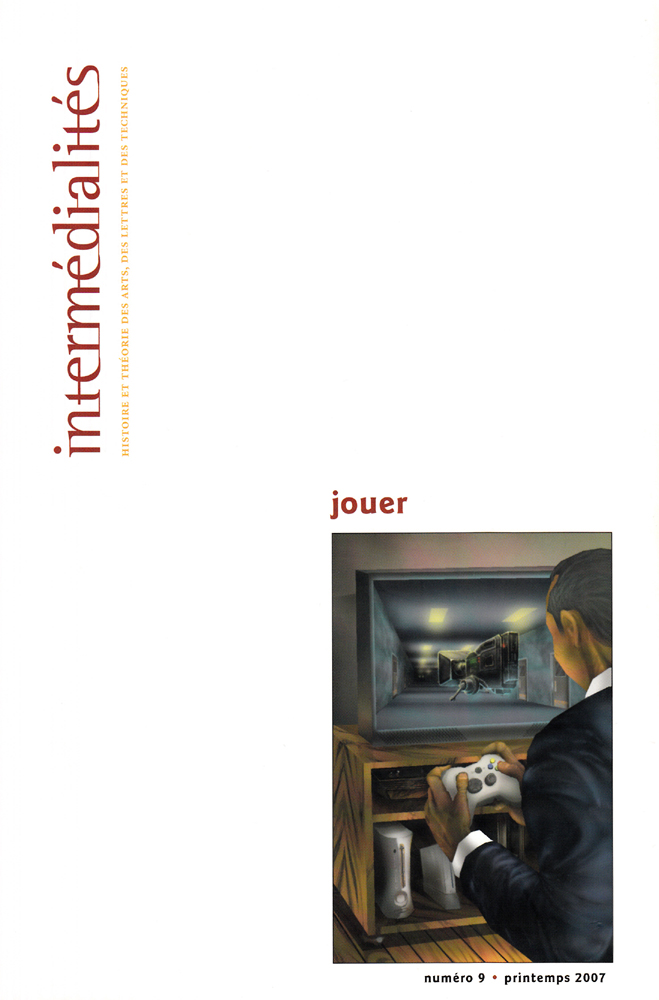
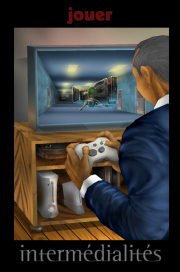
Perron, Bernard (dir.). 2007. Intermédialités, jouer. n° 9 (Fall). [Online]
Homo ludens. Johan Huizinga asserts that this term, which characterizes man as a player, may be more appropriate for our species than the names homo sapiens — man who reasons — or homo faber — man who makes. Although, as Jacques Henriot reminds us, we must resist the idea that play is “a fundamental factor in everything that happens in the world,” the importance of video games today only serves to underscore Huizinga’s conviction that “civilization arises and unfolds in and as play.”
From media arts to literature, video games to cinema, this issue offers a reflection on the gamification of culture and media. Although the texts presented differ in terms of the themes they address, they can be grouped into two distinct approaches. First, several authors have chosen to focus on the relationship between fiction and play, as well as the mediations they engender. Whether discussing the interaction between the real, the virtual, and the fictional in video games, the conflictual space between fiction and reality created by “exhibition cinema,” or a redefinition of the notion of “out of play” based on authorial and/or spectatorial activity, all emphasize the eminently playful nature of fiction. The second approach questions two fundamental theories of play: one that relates play to learning and interpretive practice, and the other that associates it with an anti-aesthetic form leading to destruction.
BOOK CHAPTERS AND ARTICLES
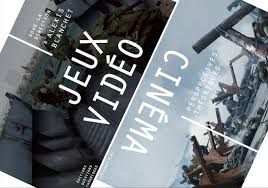
Perron, Bernard, and Martin Picard. 2015. “Petit guide en six termes pour survivre à l’approche théorique des relations entre le jeu vidéo et le cinéma.” In Alexis Blanchet (ed.), Cinéma et jeu vidéo, p. 24-37. Paris: Questions Théoriques.
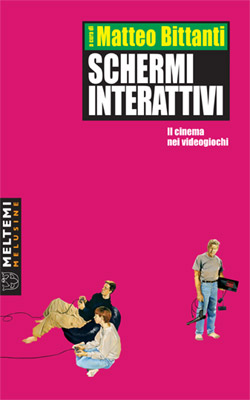
Perron, Bernard. 2008. “Dal film al gioco: l’esperienza forzata di paura.” In Matteo Bittanti (ed.), Schermi interattivi. Saggi critici su videogiochi & cinema, p. 233-259. Rome : Meltemi.
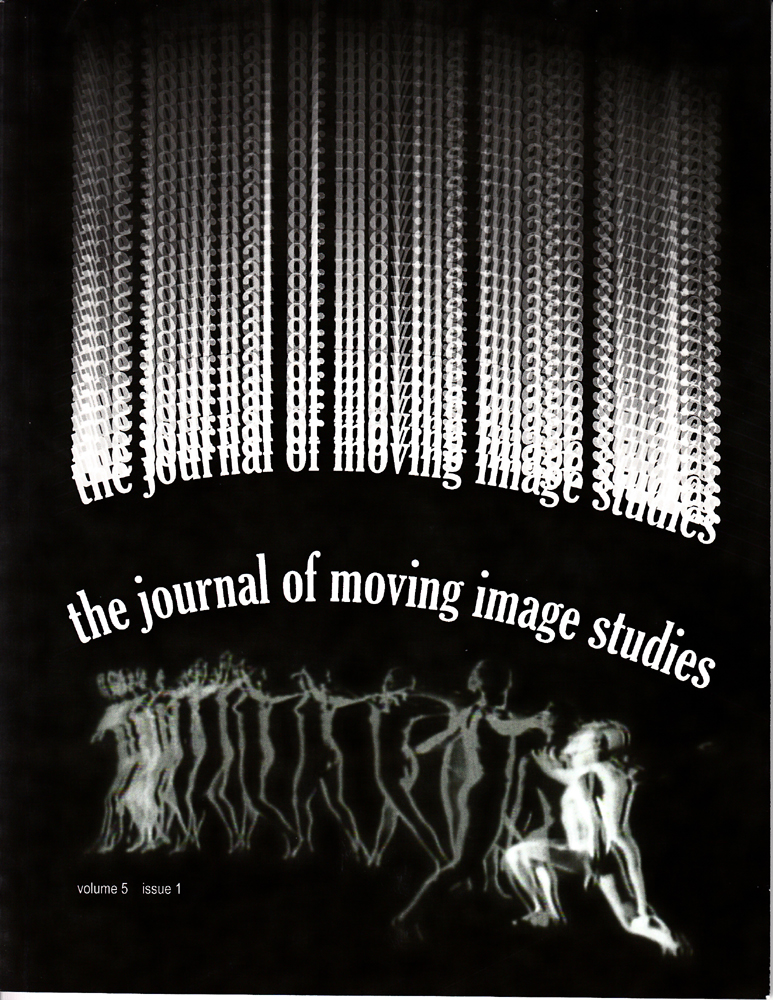
Perron, Bernard. 2007. “Anaconda, a Snakes and Ladders Game. Horror Film and the Notions of Stereotype, Fun and Play.” Journal of Moving Image Studies, vol. 5, n° 1 (December), p. 20-30. [PDF]
In a chapter of her book Les idées reçues. Sémiologie du stéréotype (1991), Ruth Amossy examines the industrialization of fear and associates horror fiction with play and games. It is precisely this relationship between stereotypes (as Barthes said, a monster hides behind every sign) and the playful spirit that this article will seek to clarify. Drawing on concepts from social cognition, cognitive psychology, literary studies, and game theory, it will examine the details of this “repetition within diversity that ensures the effect of the stereotype” (Amossy).
To achieve this, this article conducts a textual analysis of the genre film Anaconda (Luis Llosa, 1997). More specifically, it describes how this film, which introduces a giant snake as a monster, is constructed like a game of snakes and ladders. The article demonstrates how stereotypical characters, in this case the documentary film crew (consisting of a Hispanic-American director, an African-American cinematographer, a British narrator, and a white American scientist), are pawns that the director can “move around.” By respecting or subverting certain rules of the genre — with which the viewer is familiar — these “moves” also serve to “move” the viewer through space, or more precisely, through the playground circumscribed by the fiction: the Amazon River. For example, certain movements, which could be identified as ladder-like, will allow the characters and the narrative to progress normally, while snake-like movements will eliminate “pawns” or thwart the viewer’s expectations.
In conclusion, the article shows that this construction applies generally to monster and horror films (the analogy with snakes and ladders is obviously applicable without the monster being a snake) and ultimately emphasizes that it is in a playful exchange that stereotypes take on their full meaning.
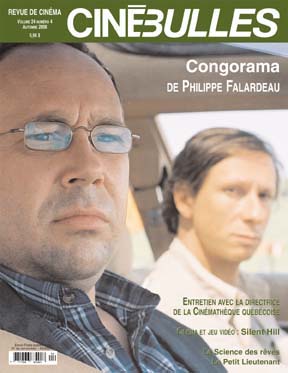
Perron, Bernard. 2006. “Quand le brouillard se dissipe : Silent Hill, le film.” Ciné-Bulles, vol. 24, n° 4 (Fall), p. 42-47. [PDF]
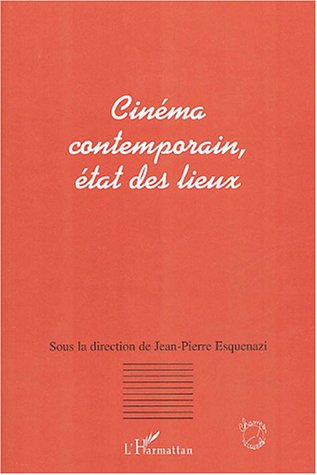
Perron, Bernard. 2004. “Pleins jeux sur le cinéma contemporain.” In Jean-Pierre Esquenazi (ed.), Cinéma contemporain : état des lieux, p. 293-308. Coll. “Champs Visuels,” Paris : L’Harmattan. [PDF]
This article examines the various relationships between cinema, video games, and the concept of play more generally. It reflects on the changes that these relationships bring about in the production, reception, and consumption of films. If, as Guy Scarpetta and others have pointed out, the advent of postmodernity has restored the value that playfulness had lost in modern cinema, video games have obviously accentuated this dimension beyond measure. “The video game craze,” noted Alain Le Diberder, “has not only boosted the film industry. It imposed a new relationship between the viewer and the narrative: interactivity” (Cahiers du cinéma, no. 503, June 1996). Thus, while there was a time when it was relevant to conceptualize the viewer as a decoder or interlocutor, today it is necessary to perceive the viewer as a player. Contemporary cinema can no longer be conceived without an important relationship to playfulness.
Other relevant publications
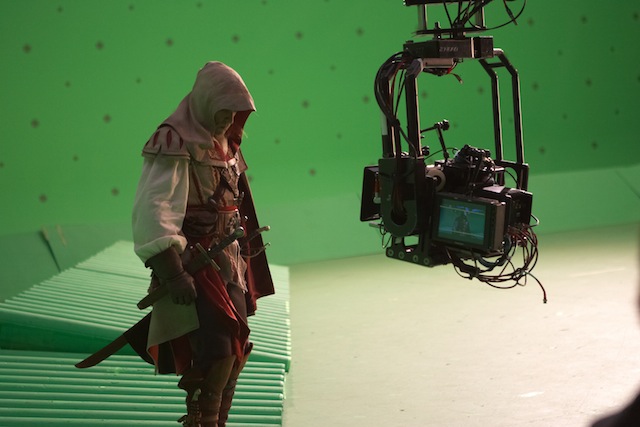
Arsenault, Dominic, and Vincent Mauger. 2012. “Au-delà de “l’envie cinématographique” : le complexe transmédiatique d’Assassin’s Creed.” Nouvelles vues : revue sur les pratiques et les théories du cinéma au Québec, Le cinéma québécois et les autres arts, n° 13 (Winter-Spring). [PDF]
Therrien, Carl. 2009. “Making Sens in Ludic Worlds. The Idealization of Immersive Postures in Movies and Video Games.” Conference proceedings for DIGRA, Breaking New Ground: Innovation in Games, Play, Practice and Theory. West London: Brunel University. [Online]
Perron, Bernard. 1999. “Un indice pour ouvrir le jeu”. Cinémas, Cinélekta 3, vol. 10, n° 1 (Fall), p. 95-110. [PDF]
The author outlines the highly fruitful analogy between games and narrative cinema. He begins by briefly defining the constituent features of the playful activity established by narrative cinema. He then examines its principles through an analysis of Clue (Jonathan Lynn, 1985), the film adaptation of the famous board game by Parker Brothers.
Perron, Bernard. 1995. “Une machine à faire penser.” Iris, La notion de genre au cinéma, vol. 20 (Fall), p. 76-84. [PDF]
Barthélémy Amengual defines genre as a “thinking machine.” Certainly, insofar as a genre film is seen as a prefabricated narrative that presupposes a set of conventions and expectations, it is relevant to study the perceptual and cognitive processes mobilized (consciously or unconsciously) while watching a film. Analyzing Steve Miner’s House (1986), the author shows how viewers are constantly engaged in a perceptual-cognitive cycle as they produce meaning and enjoy themselves within a film genre and narrative cinema in general. During this perceptual-cognitive cycle, the top-down mode of perception remains the most significant. Ultimately, the author emphasizes that the fundamentally playful space of genre (and of all narrative cinema) is almost always the scene of a confrontation between the director and the viewer.
Perron, Bernard. 1994. “La mémoire, c’est ce qu’il me reste à défaut d’une vue.” Cinémas, Le temps au cinéma, vol. 4, n° 1-2 (Fall), p. 91-103. [PDF]
Here, Filmic temporality is analyzed in relation to the constraints imposed by screening time. Because a film is screened in real time, understanding the narrative requires perceptual and cognitive effort on the part of the viewer. And filmic narration takes advantage of this viewer contribution. Analyzing Jonathan Demme’s The Silence of the Lambs (1990), the author studies the mechanisms of memory, inferential processes, and the two modes of perception (bottom-up and top-down) that are activated when watching a film. He also exposes the deception that punctuates the last part of the film.
Perron, Bernard. 1992. “Au-delà de hors-champ : le hors-scène.” Communication, vol. 13, n° 2 (Fall), p. 85-97. Québec: Université Laval, Spectateurs.